
Custom ear products need to reflect the unique shape of your ear. Two ways of recording that shape are a traditional silicone ear impression and a digital 3D scan. Neither method is automatically best for everyone: the right choice depends on your ear, the intended product and the manufacturer’s requirements.
How do traditional ear impressions work?
A trained practitioner checks the ear canal and eardrum, places a protective otoblock and gently introduces impression material into the ear. When the material has set, the impression is removed and examined before it is sent to a manufacturer. It creates a physical model of the shape needed for a custom product.
Impressions are well established, but require careful clinical technique and must not be taken if examination reveals a contraindication.
What happens during a 3D ear scan?
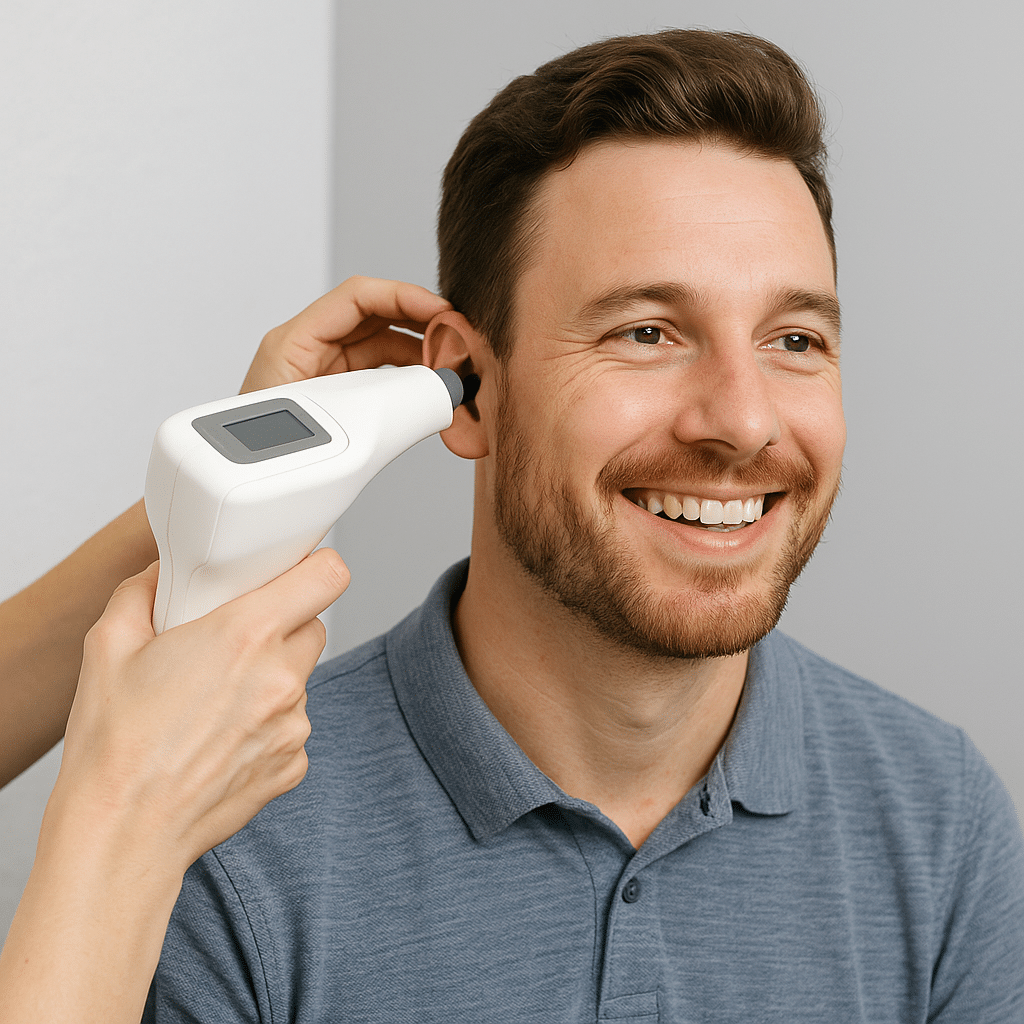
Digital systems such as Otoscan capture the shape of the ear canal and outer ear electronically. The clinician examines the ear first and uses a handheld scanner to build a three-dimensional image. Instead of sending a silicone model, the digital file can be supplied to a compatible manufacturer.
Scanning removes the need for liquid impression material in many suitable cases. However, not every manufacturer accepts every digital scan format, and not every ear can be scanned successfully.
Comparing the two methods
- Patient experience: both are normally brief. Some people prefer not having impression material in the canal.
- Production: a digital scan may simplify file transfer where the manufacturer supports it.
- Suitability: wax, infection, anatomy and medical history must be considered first.
- Quality: a careful clinician and a manufacturer-approved process matter more than the label on the technology.
What can the measurements be used for?
Depending on compatibility and the manufacturer’s specifications, ear impressions or scans may help make custom earmoulds, in-ear monitors, hearing protection and selected hearing-aid shells. The required depth and detail differ by product.
What should I expect at Wigan Hearing?
We offer digital 3D ear scanning in Standish. An ear examination comes first, followed by a discussion of the intended product and the method its manufacturer requires. We will not promise that a scan can replace every conventional impression.
Read more about 3D ear scanning, or contact Wigan Hearing to discuss a custom-ear project.
Frequently asked questions
Does a scan hurt?
The procedure should not be painful. Tell your clinician if you experience discomfort.
Is a 3D scan always more accurate?
No. Accuracy depends on the equipment, technique, anatomy and whether the receiving manufacturer supports that workflow.
Can you scan an ear blocked with wax?
A blocked canal can make the result unsuitable. The ear should be assessed before deciding what to do next.
Information reviewed October 2026. This guide is general information, not an individual diagnosis.