Choosing a hearing aid can feel confusing because there are now more styles, features and technology levels available than ever before.
At Wigan Hearing, we help people choose hearing aids based on much more than appearance. Your hearing loss, ear anatomy, dexterity, lifestyle, listening needs and personal preferences all play a part in deciding which option is most suitable.
If you’re already considering hearing aids, you can also visit our Hearing Aids Wigan page for more information about our hearing aid services, technology and appointments.
Types of Hearing Aids in Wigan
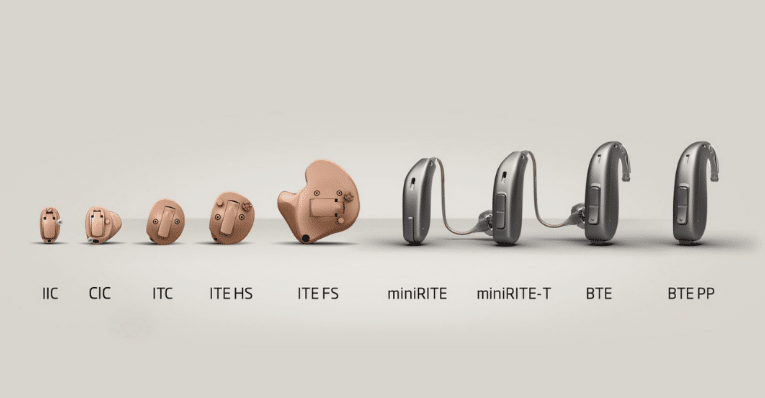
Modern hearing aids come in several different styles. Some sit behind the ear, while others fit partly or completely inside the ear canal.
There is no single style that is best for everyone. Each has advantages and potential limitations.
Receiver-in-Canal Hearing Aids (RIC / RITE)
Receiver-in-canal hearing aids are among the most commonly fitted styles today.
The main body of the hearing aid sits discreetly behind the ear, while a thin wire connects it to a small receiver positioned inside the ear canal.
RIC hearing aids can be suitable for a wide range of hearing losses and are available with many modern features, including rechargeable batteries, Bluetooth connectivity and advanced noise-management technology.
They are popular because they combine good sound quality with a relatively discreet appearance.
RIC hearing aids may be a good choice if you want:
- A discreet hearing aid
- Rechargeable options
- Bluetooth connectivity
- A wide range of technology levels
- Good flexibility if your hearing changes
The receiver and earpiece can also often be changed without replacing the complete hearing aid.
Behind-the-Ear Hearing Aids (BTE)
Behind-the-ear hearing aids sit behind the ear and send amplified sound into the ear through tubing connected to an earmould or earpiece.
BTE hearing aids are particularly useful where more amplification is required and can be suitable for mild through to severe or profound hearing losses, depending on the model.
Their slightly larger size can also make them easier to handle for people who have reduced dexterity.
Modern BTE hearing aids are considerably smaller and more sophisticated than many people expect.
In-the-Ear Hearing Aids (ITE)
In-the-ear hearing aids are custom made to fit the shape of your ear.
Rather than having a separate component behind the ear, most or all of the hearing aid sits within the outer ear.
Their larger custom shell can provide space for features such as rechargeable batteries, directional microphones and wireless connectivity, depending on the model.
ITE hearing aids may also be easier to insert and remove than very small devices, which can be helpful for people who find tiny controls difficult to manage.
In-the-Canal Hearing Aids (ITC)
In-the-canal hearing aids are smaller custom-made devices that sit mainly within the ear canal.
They are less visible than a full-shell in-the-ear hearing aid while still providing enough space for useful technology.
Whether an ITC hearing aid is appropriate depends on factors including your hearing loss, ear canal size and the features you would like.
Completely-in-Canal Hearing Aids (CIC)
Completely-in-canal hearing aids sit deeper inside the ear canal and are designed to be very discreet.
Their small size makes them attractive to people who do not want a hearing aid to be easily noticeable.
However, smaller is not automatically better.
The reduced physical space can limit battery size, controls, wireless connectivity and other features. Very small hearing aids can also be more difficult to handle if you have reduced dexterity.
Invisible-in-Canal Hearing Aids (IIC)
Invisible-in-canal hearing aids fit particularly deep within the ear canal and can be extremely difficult to see when worn.
They may be suitable for people who place a high priority on cosmetic discretion, but they are not appropriate for every ear or every hearing loss.
Your ear canal needs to have sufficient space to accommodate the device safely and comfortably.
Because IIC hearing aids are very small, there may also be compromises in battery life, power and connectivity compared with larger hearing aid styles.
Rechargeable Hearing Aids
Rechargeable hearing aids have become extremely popular.
Instead of changing small disposable batteries every few days, the hearing aids are placed into a charger, usually overnight.
For many people this makes hearing aids considerably easier to manage.
Rechargeable technology is now available across a wide range of hearing aid styles and technology levels.
It can be particularly useful if you have difficulty handling small batteries or simply want the convenience of charging your hearing aids in the same way you would charge a phone.
Which Hearing Aid Is Best for Me?
The best hearing aid is not necessarily the smallest, most expensive or newest model.
The right choice depends on several factors.
Your Hearing Loss
Different hearing aids provide different levels of amplification.
A very small invisible hearing aid may work extremely well for one person but may not provide sufficient output for someone with a more significant hearing loss.
Your hearing assessment therefore plays an important role in deciding which styles are appropriate.
Your Lifestyle
Someone who spends most of their time having quiet one-to-one conversations may have very different requirements from someone who regularly attends meetings, restaurants, social events or busy family gatherings.
Understanding where you struggle to hear helps us select technology that is appropriate for your real-world listening needs.
Dexterity and Vision
Very small hearing aids can look discreet, but they can also be harder to insert, remove and maintain.
If you have difficulty handling small objects, a slightly larger rechargeable hearing aid may actually be a much better choice.
Ear Anatomy
Not every hearing aid style will physically fit every ear.
The size and shape of your ear canal, as well as factors such as wax production and ear health, can affect which devices are suitable.
Cosmetic Preference
Some people want their hearing aids to be as invisible as possible.
Others are much more interested in performance, rechargeability or connectivity.
Modern hearing aids are available in a wide range of sizes and colours, so there is usually more than one option to consider.
Modern Hearing Aid Technology
The appearance of hearing aids has changed dramatically, but the technology inside them has advanced even more.
Depending on the manufacturer and technology level, modern hearing aids may include features such as:
- Rechargeable batteries
- Bluetooth connectivity
- Smartphone apps
- Hands-free calling
- Directional microphones
- Automatic environmental adjustments
- Speech enhancement
- Background-noise management
- Wind-noise reduction
- Feedback management
- Tinnitus support features
- Artificial intelligence and machine-learning features
The usefulness of these features varies from person to person.
A hearing aid should be selected around your hearing needs rather than simply choosing the longest list of features.
Bluetooth and Smartphone Connectivity
Many modern hearing aids can connect directly to compatible smartphones, televisions and other devices.
This may allow telephone calls, music, podcasts and other audio to stream directly into the hearing aids.
Smartphone apps can also provide access to functions such as volume adjustment, programme changes and battery information.
Connectivity differs between hearing aid manufacturers and phone models, so compatibility should be checked when selecting your hearing aids.
Why the Hearing Aid Fitting Matters
Choosing the hearing aid itself is only part of achieving a good result.
The way a hearing aid is programmed and verified is extremely important.
At Wigan Hearing, hearing aids are fitted using your individual hearing assessment rather than relying solely on generic manufacturer settings.
Where appropriate, we use Real Ear Measurements (REM) to measure the sound produced by the hearing aid while it is being worn in your ear.
This allows us to check how closely the hearing aid output matches the amplification required for your individual hearing loss.
Even two people with similar hearing test results can have different ear acoustics, which is one reason professional verification is so valuable.
Hearing Aids at Wigan Hearing
Wigan Hearing is an independent hearing clinic serving Wigan, Standish and the surrounding area.
As an independent clinic, we are able to provide hearing technology from major hearing aid manufacturers rather than being restricted to one brand.
This allows us to consider the hearing aid that best matches your individual needs.
Our hearing aid service can include:
- Comprehensive hearing assessment
- Discussion of your listening difficulties and priorities
- Advice on suitable hearing aid styles
- Access to leading hearing aid manufacturers
- Professional hearing aid fitting
- Real Ear Measurement verification where appropriate
- Follow-up appointments and adjustments
- Ongoing hearing care and support
- A 5-year warranty on hearing aids supplied by Wigan Hearing
You can find more information on our Hearing Aids Wigan page. You can also read the NHS guide to hearing aids and implants.
Frequently Asked Questions About Hearing Aids
What is the most popular type of hearing aid?
Receiver-in-canal hearing aids are currently a very popular choice because they are discreet, versatile and available with a wide range of features.
However, popularity does not necessarily mean they are the right choice for everyone.
What is the most discreet hearing aid?
Invisible-in-canal and completely-in-canal hearing aids are generally among the least visible styles.
Suitability depends on your hearing loss, ear canal anatomy and the level of technology you require.
Are rechargeable hearing aids better?
Rechargeable hearing aids can be extremely convenient and remove the need to regularly replace small batteries.
Whether rechargeable or disposable batteries are preferable depends on your individual needs and the hearing aid style you choose.
Can hearing aids connect to my mobile phone?
Many current hearing aids can connect to compatible smartphones using Bluetooth.
The exact features available depend on the hearing aid manufacturer, model and mobile phone.
How do I know which hearing aid is right for me?
The best starting point is a comprehensive hearing assessment.
Your hearing results can then be considered alongside your lifestyle, dexterity, ear anatomy, cosmetic preferences and listening requirements.
Choosing Hearing Aids in Wigan
If you are considering hearing aids, you do not need to decide which style you want before your appointment.
A hearing assessment allows us to establish the type and degree of hearing loss and discuss where you are experiencing difficulty.
We can then explain the hearing aid options that are genuinely suitable for you, including the advantages and disadvantages of each.
The aim is not simply to choose a hearing aid that looks good on paper. It is to find a hearing solution that you are comfortable wearing and that helps you hear better in the situations that matter to you.
Contact Wigan Hearing to arrange a hearing assessment or visit our Hearing Aids Wigan page to learn more.